Baked aubergine with tomatoes and mozzarella

Baked aubergine with tomatoes and mozzarella

Baked aubergine with tomatoes and mozzarella

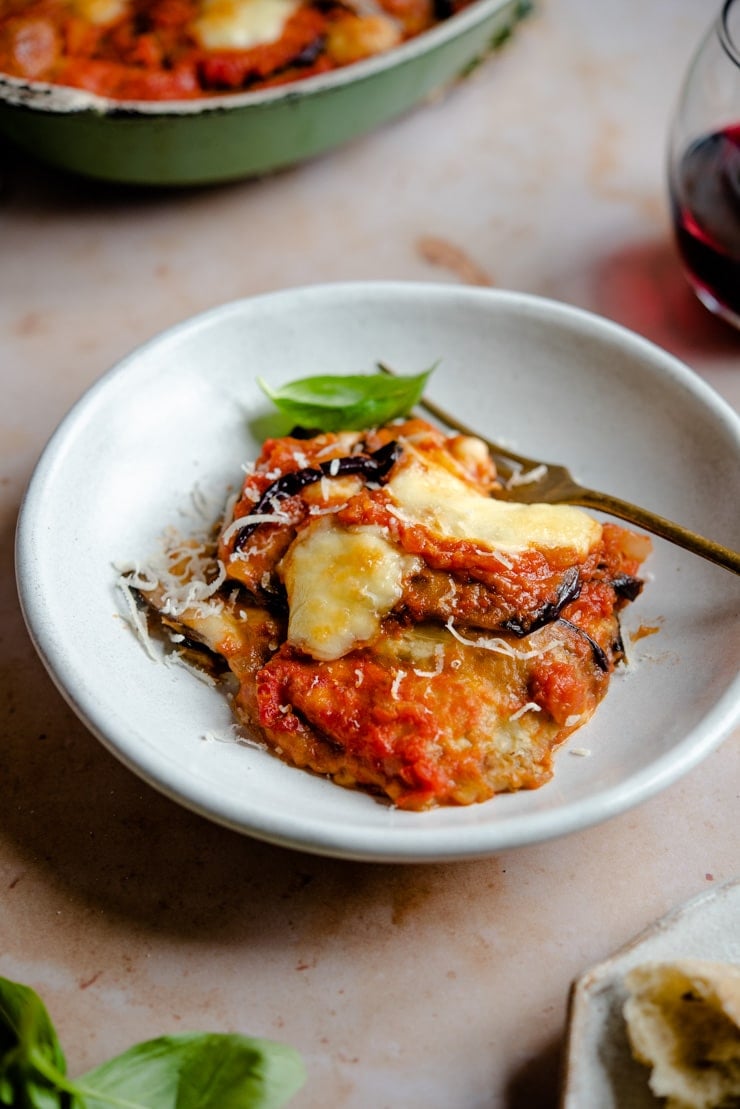
A simple yet delicious baked aubergine dish, topped with a rich cherry tomato and basil sauce
and finished with melting mozzarella – perfect for two.

Baked aubergine with tomatoes and mozzarella

Baked aubergine with tomatoes and mozzarella

Servings: 2
Total time: 40 minutes
Cooking time: 40 minutes


INGREDIENTS

  • 1 aubergine
  • 200 g cherry tomatoes
  • 1 handful fresh basil leaves (to taste)
  • 1 pinch salt (to taste)
  • 1 pinch black pepper (to taste)
  • 150 g fresh mozzarella (4 slices)
  • 2 tbsp (30 ml) olive oil
  • 1 large garlic clove, sliced
  • 1 pinch chilli flakes (for garnish)

METHOD

  1. Cut the aubergine in half lengthways and make shallow incisions in the flesh.
  2. Sprinkle with salt, drizzle with 1 tbsp (15 ml) olive oil, and bake in a preheated oven at 170°C for 15–20 minutes, depending on the size of the aubergine.
  3. Heat the remaining 1 tbsp (15 ml) olive oil in a pan. Add the sliced garlic and halved cherry tomatoes.
  4. Season with salt, cover, and cook for about 15 minutes.
  5. Add the fresh basil leaves to the pan, then use a spoon to crush the tomatoes into a thick, aromatic sauce.
  6. Remove the aubergine from the oven. Use a spoon to create a shallow well in each half, then top with the tomato sauce and mozzarella slices.
  7. Return to the oven and bake at 220°C for 5 minutes, or until the cheese is melted and bubbling.
  8. Garnish with chilli flakes and fresh basil leaves before serving.

Aubergine Parmigiana

Aubergine parmigiana

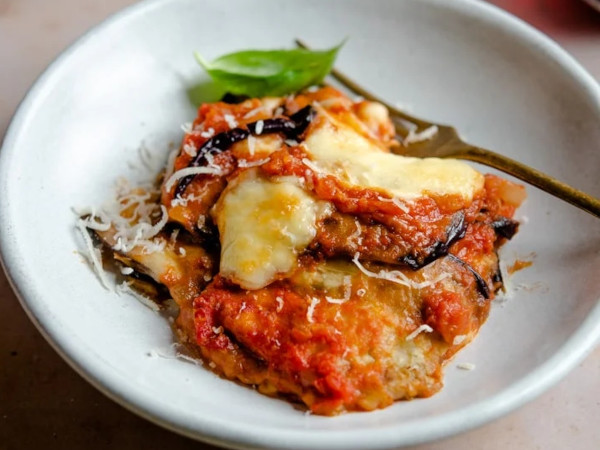
A rich baked dish of layered aubergines, tomato sauce and cheese.
Perfect as a main course for four.

Aubergine parmigiana

Servings: 4
Total time: 2h 10m


INGREDIENTS

  • 1.25 kg aubergines
  • 2 tbsp olive oil, plus extra to grease and fry
  • 800 g chopped tomatoes (2 × 400 g cans)
  • 1/2 tsp dried oregano
  • 125 g parmesan
  • Goat’s cheese or mozzarella, cut into slices

METHOD

  1. Heat the oven to 180°C (160°C fan).
  2. Cut the aubergines into 5 mm slices. Divide into two batches and cook each batch in the airfryer at 200°C for 20 minutes. Cover with a plate while cooking the second batch.
  3. Heat some oil in a frying pan (induction number 7). Working in batches, fry the remaining aubergine slices for 2 minutes on each side and transfer to a plate,
    seasoning with salt and pepper between layers.
  4. Lightly grease a medium baking dish and spread a thin layer of tomato sauce over
    the base. Sprinkle each tomato layer with oregano and seasoning. Top this with a
    layer of aubergine. Repeat the layers.
  5. Sprinkle grated parmesan cheese over the top and finish with slices of goat’s cheese.
  6. Bake in the oven for 30 minutes. Let rest for 15 minutes before serving.

Chilled Cucumber Soup

CHILLED CUCUMBER SOUP

During the summer months at the cortijo, I love making chilled vegetable soups to eat in the evening, and my favourites are salmorejo and gazpacho. I’ve recently been experimenting with other types of soup. We’ve got loads of cucumbers at the moment, so this is one I tried today.  

Chilled Cucumber Soup

INGREDIENTS

  • 500g ready-prepared cucumbers, peeled and chopped
  • 1 large clove garlic, roughly chopped
  • 1 small pot of natural yoghurt
  • 60g extra virgin olive oil
  • 20g cider vinegar
  • 60ml water
  • a couple of sprigs of mint leaves, destemmed
  • a pinch of salt

METHOD

  1. Put all the ingredients into a liquidiser and blend for 7 minutes.
  2. Pour into a bowl and chill well before serving.

My Sourdough Bread

Like many people, I started making my own sourdough in the COVID lockdown and it has been a learning experience. This is my tried and tested recipe and method for 50% brown flour/50% strong white flour loaf.

INGREDIENTS

  1. 250g strong white flour
  2. 250g brown bread flour
  3. 320g warm water
  4. 15g salt

EQUIPMENT

  • a hand blender or food processor with dough hook
  • a large stainless steel bowl
  • a spatula
  • a plastic bowl with a lid (for mixing the starter)
  • a loaf tin (this is one I buy from Amazon)

AUTOLYSE

In order to strengthen the gluten in the brown flour, I mix the flour, water and salt beforehand. This is called AUTOLYSING and it softens whole wheat flour and produces a better texture loaf. You are not supposed to add the salt at this stage but I kept forgetting it the next day so I now chuck that in too.

STARTER

Your starter is the most important thing in sourdough breadmaking. I keep mine in a small WECK jar with a wooden lid on the top shelf of the fridge, right at the back, so that no one will take it out to get to something and leave it out. It’s a good idea to have a loose-fitting lid but found that I kept breaking the original glass lids that came with the WECK jar:

3 tapas de madera Weck medianas, bonitas tapas de madera de haya. Tamaño mediano = 80 mm. Compra especial. Solo para adaptarse a tarros WECK.

FEEDING THE STARTER

I only feed my starter when I make bread. It is perfectly happy left in the fridge until then, and there is no problem if you go away for a couple of weeks. It might be a bit sluggish the first few times you use it, but it will soon pick up.

METHOD  

PREVIOUS AFTERNOON:
Take your starter out of the fridge and leave it on the counter.

PREVIOUS EVENING:
MIX THE STARTER:

I always keep back 63g of starter. When I want to make bread, I transfer it to the plastic bowl and mix it together with 63g of organic white rye flour and 63g of warm water. I then put 63g of the mixture in a clean jar and put this back in the fridge. The remaining 125g of starter mix is then covered and left overnight somewhere not too cold.

AUTOLYSE THE FLOURS:
In your large stainless steel bowl, use a hand blender or food processor to mix together the white flour (250g), the brown flour (250g), the water (320g) and the salt (15g). Cover the bowl with a large plate and leave overnight. 

BREAD-MAKING DAY
07:00: MIX FLOUR AND STARTER

I mix together the flour mixture and the starter using a hand blender or food processor.
My method for this is to spread the flour mixture as thin as possible up the sides of the bowl using the spatula. I then add the starter to the middle and fold over the sides to completely cover the starter. I then combine it thoroughly using the mixer. This is then left covered for 60 minutes.

08:00: 4 STRETCHES + 4 STRETCH&FOLDS
I first stretch the dough four times. You are basically pulling it apart between your hands. You then do four stretch and folds. Rather than explaining how to do this, it is probably easier to show you what I mean by this, so here is a video:
https://www.youtube.com/watch?v=eFaKId5ijNg

You then repeat the stretch and folds four more times every 30 minutes:

08:30 STRETCH&FOLD 1

09:00 STRETCH&FOLD 2

09:30 STRETCH&FOLD 3

10:00 STRETCH&FOLD 4

10:00 PROVING THE BREAD – 3 HOURS
Once you have finished all the stretch and folds, you prove the bread for 3 hours. For this, I place the bread in the loaf tin and put it in a warm place with a cloth over it.

Fortunately, I have a bread rising setting on the oven which keeps it at 40ºC. You should not use any higher temperature as this will start to cook the bread. 

In order to stop the dough sticking to the tin, I line the loaf tin first. You can use greaseproof paper for this. However, I prefer to make my own liners from BBQ silicone liners so that I can reuse them.

Here is a video to explain how:
https://www.youtube.com/watch?v=SnVogHJ5kFM

This is a photo of the bread once it has been proved:


13:00 BAKING THE BREAD – 60 MINUTES

Remove the loaf tin from the oven. Heat the oven to 180ºC and then bake the bread for 60 minutes.

Remove the bread from the tin and leave to cool.

Honey and Onion Homemade Cough Expectorant

HOME-MADE COUGH MEDICINE RECIPE

This recipe was  given to me by the chemist in the village. I’ve no idea whether it works or not but thought we would give it a try.


METHOD

Cut two medium-sized onions into quarters and place in a bowl.

Spoon over 4-5 dessertspoons of honey.

Mix well and leave until the next day.

Strain off into a light-proof bottle.

Take a teaspoon of mixture every 4 hours.