Gazpacho

gazpacho tomatoes

GAZPACHO

This is my second recipe for gazpacho. My first recipe (Andalusian gazpacho) is the more traditional recipe that uses onion, cucumber, garlic, green pepper and garlic, but today I wanted to make a more tomato-based, thinner version like the one they serve in glasses in bars in towns around Andalucía, and Sevilla where I have fond memories of it from.

You must use ripe tomatoes with plenty of flavour for this recipe. Our tomatoes are generally ready at the beginning of August, so if I fancy making this before then, I will use plum tomatoes which tend to have more flavour than other early varieties.

This recipes serves two but it can be easily adapted.

Gazpacho

It only takes a few minutes to prepare this refreshing, cold tomato soup which is perfect for hot, summer days.


INGREDIENTS

  • Tomatoes
  • 1/2 cup water
  • 4 cloves garlic
  • extra virgin olive oil
  • cider vinegar
  • 2 capfuls balsamic vinegar
  • cider vinegar
  • 50g stale bread
  • ½ cup water
  • salt

METHOD

  1. Core and roughly chop the tomatoes and add to a food blender with the garlic.
  2. Blend for a couple of minutes.
  3. Add the balsamic vinegar, a good glug of extra virgin olive oil, a splash of cider vinegar and a teaspoon of salt, and blend well.
  4. Roughly chop the stale bread and add to the blender with a teaspoon of home-made mayonnaise.
  5. Add the water and continue to blend.
  6. Chill thoroughly before serving.

Vegetarian Tofu Burgers


vegetarian tofu burgersVEGETARIAN TOFU BURGERS

These vegetarian burgers are made from tofu and are flavoured with marmite and soy sauce. They hold together well and can be fried in a frying pan or cooked on the barbeque.

vegetarian tofu burgers

Vegetarian Tofu Burgers

These burgers can quickly be whipped up in advance and fried or cooked on the BBQ the next day.


INGREDIENTS

  • 200g block of firm tofu, cut into chunks
  • 1 large onion, finely chopped
  • 3 large cloves garlic, crushed
  • 1 1/2 cups rolled oats
  • 2 teaspoons Marmite
  • 2 tablespoons soy sauce
  • ½ teaspoon salt
  • 8 slices of cheddar or Havarti cheese

METHOD

  1. Heat some extra virgin olive oil in a frying pan.
  2. Add the chopped onion, season with salt and pepper, and fry gently until soft slightly caramelised.
  3. Remove from the heat after another couple of minutes.
  4. Add the tofu, garlic, Marmite, soy sauce to the food processor and blitz until smooth.
  5. Transfer to a bowl and add the rolled oats, fried onion and salt.
  6. Mix well and leave for at last 30 minutes or overnight to allow flavours to develop and the oats to soften.
  7. Divide the mixture into 8 balls of about 80g each.
  8. Keep a bowl of cold water handy and wetting your hands constantly, shape the balls into round patties about 3cm thick.
  9. Put on a plate and keep in the fridge until you are ready to fry them.
  10. Heat some extra virgin olive oil in a frying pan.
  11. Fry the burgers for about 5 minutes on each side, turning once so that they get a nice colour.
  12. Put a slice of cheese on each burger, turn off the heat and cover the pan to melt the cheese.

Strawberry Jam

Strawberry Jam

STRAWBERRY JAM

Now that the strawberry season is well under way and we are getting lots of delicious, ripe strawberries, I thought it would be a good idea to make some jam. In the past, I’ve used a different, quicker method that makes a runnier jam, but this time I wanted a more solid one.

This recipes uses 40% sugar so as we had picked 2.2kg of strawberries, I added 880g sugar.

strawberry jam

Strawberry Jam

A simple recipe for delicious strawberry jam.


INGREDIENTS

  • Freshly picked strawberries
  • White sugar
  • Clean jars

METHOD

  1. Squash and squeeze the strawberries and the sugar together through your fingers to break most of them up while still keeping a good deal of texture.
  2. Transfer the strawberries with a draining spoon to a colander over a bowl.
  3. Bring the remaining syrup to the boil and keep it on a high heat, stirring every now and again, until it has reduced right down. It is important to keep stirring it to make sure that it doesn’t caramelise. It is best to use a wide, deep pan for this part.
  4. To check that the syrup is at the right consistency, put a teaspoonful on a plate and place in the freezer for 5 minutes. Draw your finger through the middle of the blob to see what consistency it will have when cold.
  5. When it has reached you desired consistency, add the drained strawberries back to the syrup and mix thoroughly.
  6. Spoon the jam into clean jars and tighten the lids.
  7. Invert the jars for an hour before turning back the right way up.

Non-stick Cake Liners for Baking Tins

NON-STICK CAKE LINERS FOR BAKING TINS

In this post, I explain how to make your own non-stick, reusable baking liners for circular cake tins from fibreglass grill mats.

I have recently started experimenting with cooking and making cakes in the breadmaker. I found a recipe for brownies that I liked but I wanted a quick method that could be whipped up in minutes, without the faff of having to prepare the cake tin. Although greaseproof paper was the easiest thing to use, I wasn’t happy with the fact that you have to buy it and you can’t reuse it, and so thought about the idea of reusable cake liners. When I started looking, these do exist,  but they tend to be expensive and I saw one for about 30 euros on an Australian site.

BARBECUE MATS AND OVEN LINERS

After a bit of thought, I came up with the idea of using the grill mats that you can buy to keep your barbecue or the bottom of your oven clean. These are generally made of fibreglass and can withstand high temperatures. They are also quite thin (2mm thick) and so can be cut with scissors. I knew from the size of the greaseproof paper that I used to line the cake tin that the mats would have to be at least 34cm wide. As I’ve got a round cake tin, I also bought a compass.

MARKING THE GRILL MAT

I set the compass to the internal radius of the cake tin (8.75cm) and drew a circle in the middle of the grill mat. I put the point of the compass on the diameter and marked the points where the compass crossed to divide the circumference evenly into six.

The internal radius was 8.75cm and the sides measured 10cm. Adding these two figures together, I set the compass to this new measurement and drew a second circle with the same central point as before.

I cut out the grill mat round the second circle.

Using a ruler, I lined up opposite intersecting points on the first circle. I drew a line through them to connect the two circles. I then cut down from the outer circle to the first circle.


Making Garlic Mayonnaise with a Stick Blender

cortijoblog: making mayonnaise with a stick blender

MAKING MAYONNAISE

Although traditional garlic mayonnaise or “aïoli” is only made with egg yolks, I wanted to find a recipe that used the whole egg to take full advantage of the eggs that our hens lay.

In a previous post, I described my first way of making mayonnaise with a stick blender using 1 large egg and 250ml of sunflower oil. Although this original method is fine if you have large eggs, it doesn’t tend to work so well if you have younger hens laying smaller eggs. I also wanted a way of making larger quantities and so I developed the method shown on this page.

The mayonnaise only takes a couple of minutes to make. As long as you use large eggs at room temperature, the mayonnaise will set properly. If you have smaller eggs, then I recommend you use three, blending two together in the first part of the process and using the third in the second stage.

The key to success is to slowly raise and lower the stick blender, using a circular motion to incorporate all of the mixture thoroughly. This method works best if you use the long tall jar that comes with the stick blender.

Here is a link to the video of me making this mayonnaise: 


INSTRUCTIONS

cortijoblog: making mayonnaise with a stick blender

INGREDIENTS

  • 250ml or a cup of sunflower oil
  • 2 large eggs at room temperature
  • 2 teaspoons Dijon mustard
  • 2 pinches of salt
  • 4 large cloves of garlic

cortijoblog: making mayonnaise with a stick blender

METHOD

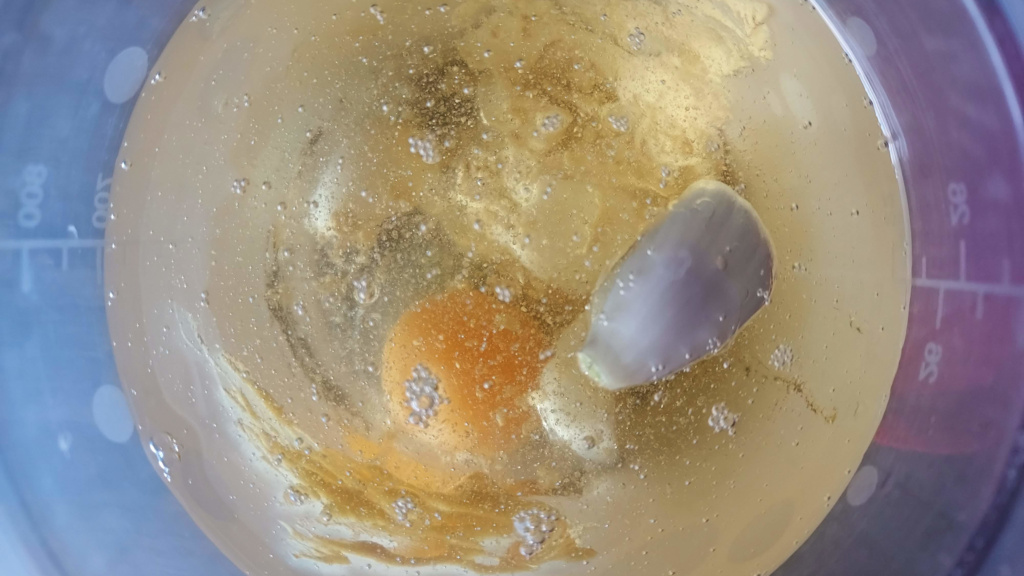
  1. Put  one of the eggs, the garlic cloves, sunflower oil, mustard and salt into the tall blender bowl.
  2. Using the stick blender, quickly blend all of the ingredients together on the fastest setting possible.
  3. Crack in the second egg.
  4. Gently lower the stick blender to the bottom directly over the egg yolk.
  5. On the fastest setting of the blender, blend for a couple of seconds.
  6. Slowly lift and lower the blender, first by about 5mm and then 10mm.
  7. Continue blending, gradually raising the blender by a couple of centimetres each time.
  8. As you lift and lower the blender, use a circular motion from front to back.
  9. You should be able to see how mixture lightens at the bottom of the bowl as the mixture turns into mayonnaise.